The short answer: An assumable mortgage lets a Triad NC buyer take over a seller's VA, FHA, or USDA loan at its original rate. On $340,000 at 3.25% for 25 remaining years, the payment is $1,657 per month. Financing new at today's 6.67% Freddie Mac average runs $2,187. That is $530 saved monthly and roughly $290,000 in interest never paid.
What Is an Assumable Mortgage in North Carolina?
An assumable mortgage is a home loan the buyer takes over from the seller instead of getting a brand new loan. The buyer inherits the original interest rate, remaining loan balance, and remaining term. In a market where new mortgage rates sit at 6.67% (Freddie Mac Primary Mortgage Market Survey, August 13, 2026) and thousands of Triad homeowners still hold loans from 2020 through 2022 at 2.75% to 3.5%, that rate spread is real money.
Three federal loan programs allow assumption in 2026: VA loans, FHA loans, and USDA loans. Conventional loans backed by Fannie Mae or Freddie Mac carry a due-on-sale clause that stops most assumptions before they start. That is why assumable mortgages account for roughly 24% of outstanding US mortgages but under 2% of actual home purchase activity — buyers and agents on both sides often don't know they qualify.
2026 Assumable Mortgage Math on a Real Triad Home
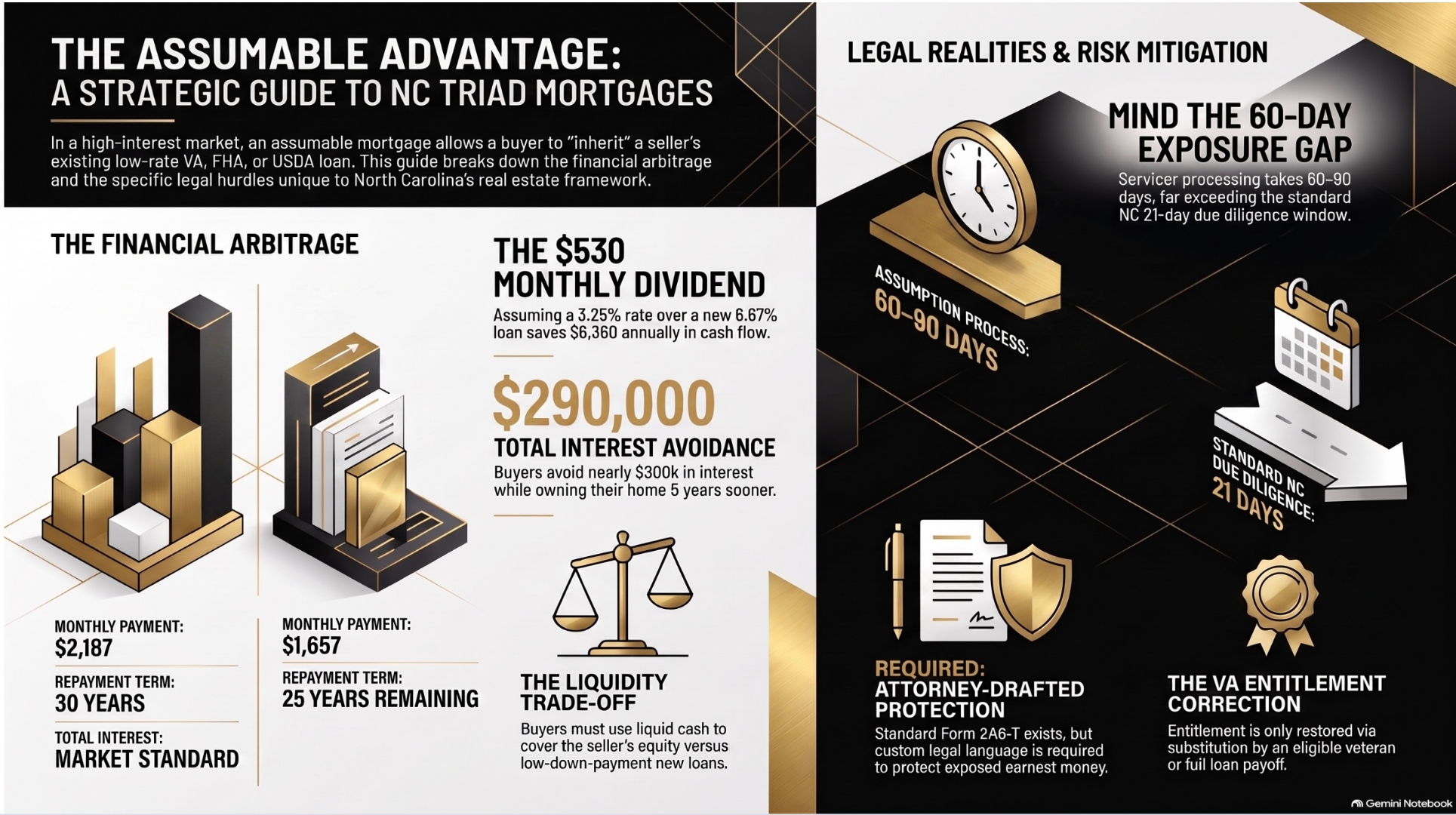
Here is the honest comparison on a typical Winston-Salem or Greensboro purchase where the seller holds a VA loan at 3.25% with 25 years remaining, and the buyer assumes it instead of financing new for 30 years at today's market average.
| Scenario | New Loan at 6.67% × 30 Years | Assumed VA Loan at 3.25% × 25 Years | Buyer Difference |
|---|---|---|---|
| Loan amount financed | $340,000 | $340,000 | Same |
| Remaining term | 30 years (new) | 25 years (inherited) | Paid off 5 years sooner |
| Monthly principal and interest | $2,187 | $1,657 | $530 per month saved |
| Annual P&I savings | Baseline | — | $6,360 per year |
| Total interest paid to term | $447,000 | $157,000 | Roughly $290,000 saved |
| Cash to seller for equity | Not applicable | Seller's built-in equity | Buyer must cover in cash |
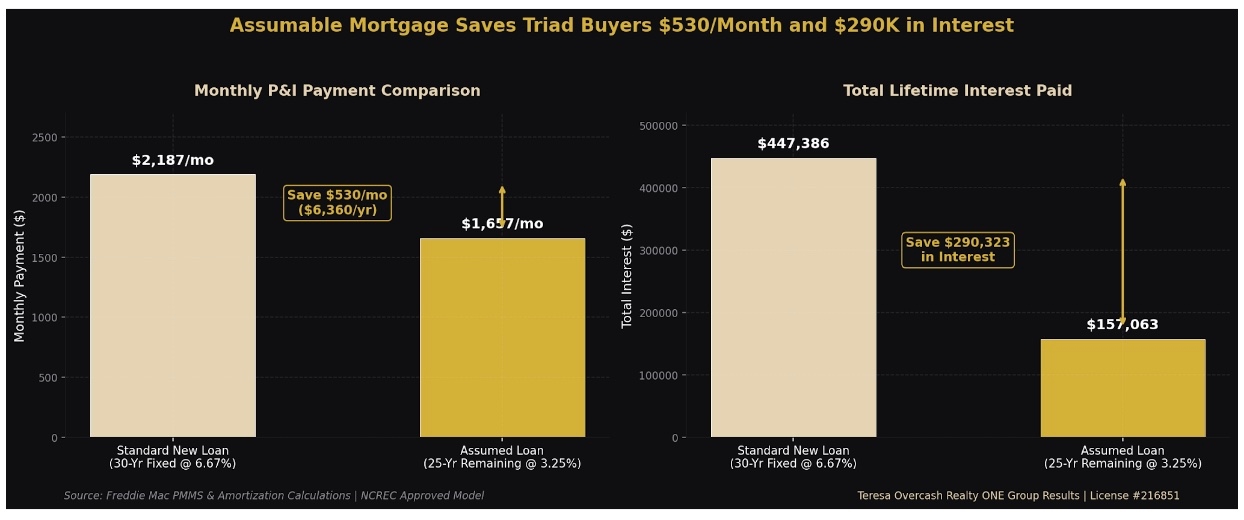
The math survives a calculator this time. Every dollar figure above ties to a real amortization at 6.67% and 3.25%, using the Freddie Mac benchmark from the week of August 13, 2026 for the new-loan side.
Video: The 60-Day Assumption Trap — the exposure gap that catches Triad buyers
Seven-minute breakdown of assumable mortgage math on a $340,000 Triad home. Covers the $530 monthly savings, $290,000 in lifetime interest never paid, the Day 0 to Day 60-90 timeline trap where nonrefundable due diligence money is exposed weeks before servicer approval, the VA entitlement lock that hits veteran sellers who take a civilian assumption, and Form 2A6-T contract mechanics with attorney-drafted refund language. From Teresa Overcash, Broker in Charge, Realty ONE Group Results.
Assumable Mortgage NC 2026 Mind Map
Explore the full assumable mortgage decision framework as a clickable mind map. Click any branch (loan eligibility, cash trade-off, VA entitlement mechanics, Form 2A6-T timing, servicer approval) to drill into the tactic.
The Cash Trade-Off Nobody Talks About
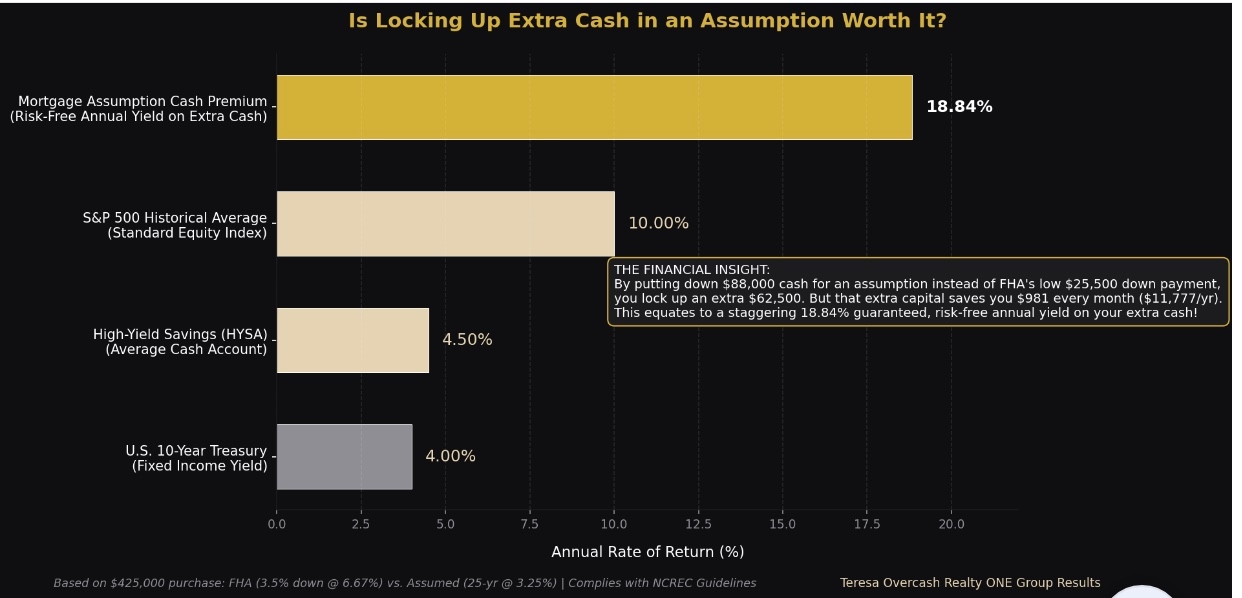
This comparison assumes the same $60,000 in down payment either way. But that's not how these loans really work side by side. FHA requires 3.5% down. VA requires zero down. If you are buying with an FHA or VA loan and could get in for a fraction of $60,000 out of pocket, the honest question becomes whether tying up $60,000 in cash to assume the seller's equity is worth $530 per month.
For a buyer who has that cash reserve and no better use for it, the assumption is a strong win. For a buyer who is stretching to cover a down payment and closing costs, keeping the cash liquid and financing new at today's rate can be the smarter play — even at a higher monthly payment. The right answer depends on the buyer's whole balance sheet, not just the payment column.
Which Loans Are Assumable in 2026?
| Loan Type | Assumable | Buyer Qualification | Assumption Fee | Timeline |
|---|---|---|---|---|
| VA loan | Yes | VA credit approval, does not require veteran status | $300 processing plus 0.5% funding fee | 60 to 90 days |
| FHA loan (post-1989) | Yes | FHA credit approval, must occupy as primary residence | $900 to $1,600 | 45 to 75 days |
| USDA loan | Yes | USDA income limits apply if buyer wants same-terms transfer | Roughly $50 plus lender charges | 60 to 90 days |
| Conventional (Fannie or Freddie) | Almost never | Due-on-sale clause blocks it | Not applicable | Not applicable |
| Portfolio or private loan | Sometimes | Lender-specific approval | Varies widely | Varies widely |
The VA rule is the one most buyers miss: you do NOT have to be a veteran to assume a VA loan. Any buyer with acceptable credit can qualify. But the entitlement mechanics behind that fact are what most sellers get wrong — and that is its own section below.
The VA Entitlement Trap Every Seller Should Understand
If a veteran seller allows a non-veteran to assume the VA loan, the seller can get a release of liability from the servicer. That release does one specific thing: it protects the seller's credit if the assuming buyer ever defaults down the road. Good, and necessary.
What the release does NOT do is restore the seller's VA entitlement. That is the myth that costs veterans real money. VA entitlement is restored only when one of four things happens: an eligible veteran buyer substitutes their entitlement for yours through the VA, the loan is paid off in full, the loan is refinanced out of VA into a conventional or other loan, or the property sells again to a veteran who substitutes entitlement.
Practical translation: a veteran seller who takes an assumption from a civilian buyer and gets a release of liability still has their VA benefit tied up in that property. They cannot use it to buy their next home with zero down until one of those four events happens. Nobody tells veterans this at the closing table. They find out when they try to buy their next house and the VA says no.
How the NC Assumption Process Actually Works
The buyer identifies an assumable loan through a listing agent who knows to ask, through the seller's disclosure, or through an assumption marketplace like Roam or AssumeList. Then the buyer applies with the seller's loan servicer — not with a new lender. The servicer runs its own credit and income underwriting on the assuming buyer. If approved, the loan transfers at closing along with the deed.
The buyer brings cash to cover the seller's equity plus the assumption fees. In the Triad, that cash requirement is often the sticking point. Sellers who bought in 2020 to 2022 typically have $60,000 to $180,000 in equity today, all of which the buyer must fund at closing. Some buyers bridge this with a second mortgage or a HELOC on the new property, but stacking financing gets complicated fast.
NC Form 2A6-T: The Real Contract Protection Story
North Carolina does have a standard assumption addendum. NCAR Form 2A6-T, the Loan Assumption Addendum, is referenced right on page 1 of the standard Offer to Purchase and Contract Form 2-T. So the paperwork exists. The problem is subtler than "there is no form."
The problem is timing. Form 2A6-T alone does not protect you, because a 60 to 90 day servicer approval timeline runs against a 21-day due diligence window. Your due diligence fee is nonrefundable long before you know whether the servicer will actually approve the assumption. Form 2-T (rev. 7/2026) does require the fee to be refunded in five specific situations: seller material breach under Paragraph 23(b), seller's failure to deliver the Residential Property and Owners Association Disclosure Statement under Paragraph 5(d), failure to deliver the Mineral and Oil and Gas Rights Mandatory Disclosure Statement under Paragraph 5(e), an uncured material governmental violation under Paragraph 8(h), or the property not being in substantially the same condition at Closing under Paragraph 11(a). Your money is exposed for weeks with no guarantee the deal is even possible.
This is where attorney-drafted language earns its fee. A protective addendum extends the buyer's outs specifically for assumption denial: it ties the due diligence period, or a separate assumption-approval period, to the servicer's actual decision rather than a fixed calendar date. It defines what "denial" means — servicer credit denial, income denial, servicer processing beyond a stated deadline — and specifies that the due diligence fee is refunded on those specific outcomes. Your closing attorney should draft this before you sign, not after. Standard NCAR Form 2A6-T alone is a starting point, not a finish line.
Where to Find Assumable Mortgages in the Triad
| Source | How It Works | Coverage |
|---|---|---|
| Roam (roam.co) | Consumer marketplace, agent commissions covered, curated inventory | Roughly 8,000 US listings, growing in NC monthly |
| AssumeList (assumelist.com) | Buyer-side platform matching FHA and VA holders with buyers | Under 2,000 US listings but strong VA coverage |
| Direct MLS search with buyer agent | Filter by "assumable" boolean, ask listing agents directly | Depends on agent knowledge and seller disclosure |
| Off-market Realty ONE Group Results team | Access to seller intent database across 4 MLS regions | Winston-Salem, Greensboro, High Point, Kernersville plus High Country and Wilkes coverage |
The best assumable candidates in the Triad are properties owned by military families near Fort Bragg who relocated to Winston-Salem or Greensboro with VA loans between 2020 and 2022. That cohort is now in year 4 to 6 of ownership with meaningful equity and locked-in low rates. Ask.
Free Assumable Mortgage Savings Calculator (Download)
Run your own numbers. Download the assumable mortgage savings calculator built by the Realty ONE Group Results team. It uses proper amortization formulas (Excel PMT), a side-by-side new-loan vs assumed-loan analysis, the cash-to-close trade-off section, and a full NCREC-standard regulatory audit including Form 2A6-T timelines, VA entitlement mechanics, and FHA/USDA occupancy rules.
Editable inputs: purchase price, assumed loan balance, seller rate, remaining term, current market rate, new-loan down payment percent, and estimated assumption fees. The model outputs monthly savings, annual savings, lifetime interest avoided, and the cash-on-cash yield on the extra cash required for the assumption.
Frequently Asked Questions
Do I have to be a veteran to assume a VA loan in NC?
No. Any qualified buyer can assume a VA loan regardless of military service. But if the assuming buyer is not a veteran, the seller's VA entitlement stays locked in that loan until the loan is paid off, refinanced out, the home is sold to another veteran who substitutes entitlement, or the VA otherwise releases the entitlement. This matters most to the seller, not the buyer.
Does a release of liability restore my VA entitlement?
No. A release of liability protects a veteran seller's credit if the assuming buyer defaults. It does NOT restore the veteran's VA benefit for use on the next home purchase. Entitlement is restored only through substitution by an eligible veteran buyer, full loan payoff, refi-out of VA, or resale to a veteran who substitutes entitlement. Many veterans learn this too late.
How much cash does a Triad buyer need to close on an assumable mortgage?
The buyer pays the seller's equity in full at closing plus assumption fees. In today's Triad market, sellers who bought during 2020 to 2022 typically hold $60,000 to $180,000 in equity, so the buyer needs that amount in cash unless a second-lien HELOC or bridge product is stacked on top. This is why assumptions favor buyers with strong down-payment savings.
Is the monthly savings worth tying up $60,000 in cash?
Depends on the buyer. If FHA at 3.5% down or VA at zero down would let you keep $60,000 in reserves or invested, the honest math has to weigh that opportunity cost against the $530 per month. For a cash-rich buyer with no better use for that money, the assumption is a strong win. For a stretched buyer, financing new at 6.67% and keeping cash liquid can be smarter.
How long does an FHA or VA loan assumption take in North Carolina?
Plan for 60 to 90 days from executed contract to closing. The seller's loan servicer runs its own credit underwriting on the assuming buyer and processes assumptions on a slower cycle than new-purchase underwriting. This is why NCAR Form 2A6-T alone doesn't protect the buyer — the servicer timeline runs long past the standard 21-day due diligence window.
What NC contract form covers loan assumptions?
NCAR Form 2A6-T, the Loan Assumption Addendum. It is referenced on page 1 of the standard Form 2-T Offer to Purchase and Contract. But 2A6-T alone is not enough protection. Your closing attorney should draft additional language tying the buyer's outs to the servicer's actual approval decision, not a fixed calendar date.
Can I refinance an assumed mortgage later if rates drop?
Yes. Once the loan is in the assuming buyer's name, that buyer can refinance any time at prevailing market rates. Many buyers assume a low-rate loan as a short to medium-term win, then refinance later if 30-year rates drop below 5%. The assumption itself does not restrict future refinancing.
Are assumable mortgages advertised on the Triad MLS?
Not consistently. The MLS has a boolean "assumable" field but many listing agents leave it blank. Roam and AssumeList marketplaces are more reliable inventory sources. A buyer agent with a strong direct-agent network across 4 MLS regions can also identify assumable inventory before it hits public listings.
Can I assume a conventional Fannie or Freddie mortgage?
Almost never. Both agencies enforce due-on-sale clauses that require the loan to be paid off when the property transfers. Rare exceptions exist for divorce transfers, inheritance, and family LLC transfers, but standard buyer-seller assumption of a conventional loan is not possible in 2026.
Thinking about assuming a Triad mortgage or listing your VA or FHA home as assumable? Call or text 336-262-3111 or email teresatedder@gmail.com to walk through your specific numbers before you sign anything. Realty ONE Group Results operates across 4 MLS regions and 22,000+ agents — enough reach to find assumable inventory that never hits the public MLS, and enough experience to draft the addendum that actually protects your money.
Inherit a 3 Percent Mortgage Rate
27 minutes on how Triad and NC High Country buyers assume seller VA, FHA, and USDA loans to save $530 per month and roughly $290,000 in lifetime interest. Full walk-through of Form 2A6-T timing, the 60-90 day servicer trap, VA entitlement mechanics, and when the cash trade-off is worth it.
Also available on Homes in Triad NC Podcast — Spotify, Apple Podcasts, Amazon Music.
Sources: US Department of Veterans Affairs Loan Assumption and Entitlement Restoration Guidelines (2026), HUD FHA Assumption Rules Handbook 4000.1 (2026 update), Freddie Mac Primary Mortgage Market Survey (August 13, 2026 — 30-year fixed at 6.67%), Roam Market Report Q2 2026, AssumeList NC Coverage Report 2026, NC Association of Realtors Form 2-T Offer to Purchase and Contract, NCAR Form 2A6-T Loan Assumption Addendum, Federal Reserve Bank of St. Louis MORTGAGE30US series. Teresa Overcash: NCREC License 216851, NCREC Instructor Certification, Broker in Charge Realty ONE Group Results.